Likes, Follows, and Bookings: How TikTok Is Minting the Next Wave of Club DJs
Not long ago, breaking into the DJ world meant years of hauling gear to low-paying gigs, handing out USB drives at record shops, and hoping a promoter with pull happened to walk into the right basement party on the right night. That path still exists. But right alongside it, a completely different road has opened up — one that runs straight through your phone screen.
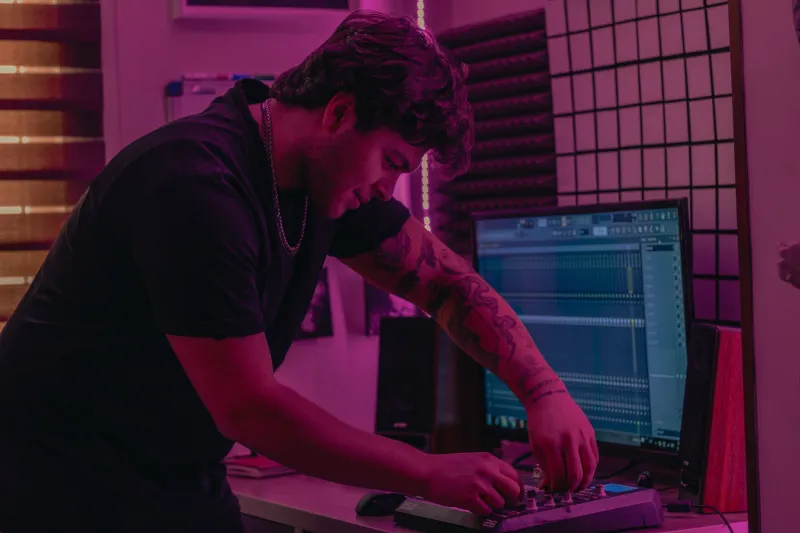
TikTok has quietly become one of the most powerful talent pipelines in electronic music. And the people figuring that out fastest aren't industry veterans. They're 22-year-olds in their apartments, recording themselves behind a controller at midnight, racking up hundreds of thousands of views before they've ever played a real venue.
Thirty Seconds That Change Everything
The math is brutally simple. A great mix posted at the right moment can reach more ears in 48 hours than a residency at a mid-tier club reaches in a year. That's not hyperbole — that's the current reality of how attention moves on the internet.
DJs like Chicago-based Mara Solís have lived this firsthand. She started posting short mix clips in late 2022, mostly as a way to practice her transitions and get feedback from friends. Within six months, she had a following that club promoters in her city were suddenly very interested in.
"I didn't set out to build a brand," Solís says. "I just liked showing people what I was hearing. But then promoters started sliding into my DMs asking if I played out. That was wild to me. I'd only done a couple of house parties at that point."
Her story is becoming less unusual by the month. Across the US, a growing number of emerging DJs are finding that a strong TikTok presence is functioning as a kind of audition reel — one that's always running, always accessible, and capable of generating social proof that a club's own Instagram page can't fake.
What Club Owners Are Actually Seeing
The reception from venue operators is more nuanced than a simple thumbs up or thumbs down. Some promoters are fully bought in. Others are cautiously watching. A few are openly skeptical.
Dave Herrera, who books talent for a mid-sized club in Austin, says he's started actively checking TikTok as part of his vetting process — but not in the way you might think.
"I'm not booking someone just because they have a million followers," he says. "What I'm looking at is the comment section. Are people talking about wanting to see them live? Are they asking about tour dates? That tells me way more than the follower count."
Herrera's point gets at something important: TikTok fame and dance floor credibility are related, but they're not the same thing. A clip that goes viral because of a funny on-screen reaction or a trending sound might have nothing to do with whether that DJ can actually hold a room for four hours at 1 AM.
On the other side of the debate is Keisha Odom, who runs a series of club nights in Atlanta focused on house and afrobeats crossover sounds. She's booked three TikTok-native DJs in the past year and says the results have been consistently strong.
"The kids who follow them on TikTok actually show up," she says. "That's not always the case with established names who have big reputations but smaller local pull. When someone has a real TikTok community, those people feel personally connected. They come out."
The Content Game Is Its Own Skill Set
What's becoming clear is that succeeding on TikTok as a DJ requires a skill set that has almost nothing to do with beatmatching. You have to understand pacing, visual framing, caption writing, trending sounds, and the platform's unpredictable algorithm. It's essentially a second job — one that some DJs are embracing and others are quietly resenting.
LA-based DJ and producer Theo Nakamura has amassed a following of over 400,000 on TikTok, mostly through a series of "if you like X, try this" format videos that introduce his audience to deeper cuts from genres they already enjoy. He's candid about the trade-off.
"There are days I spend more time editing a 45-second video than I spend actually practicing," he says. "That's a weird place to be as a musician. But I also can't ignore the fact that TikTok has gotten me gigs in cities I've never even visited. So I keep doing it."
For Nakamura, the key has been staying genuine to his actual taste rather than chasing whatever sound is trending on the platform at any given moment. He's watched other DJs pivot their entire aesthetic to match a viral moment and then struggle to rebuild when that moment fades.
Does Viral Translate to the Dance Floor?
This is the real question hanging over the whole conversation. And the honest answer is: sometimes yes, sometimes no.
The DJs who seem to make the smoothest transition from TikTok to club rooms are the ones who were already serious about their craft before the algorithm found them. Their social presence accelerated their visibility, but it didn't manufacture their skill. The ones who built their following purely on content strategy — without the technical foundation to back it up — tend to struggle when the lights come up and the crowd expects something real.
But here's the thing: that's always been true. The DJ world has always had people who talked a bigger game than they could play. TikTok just made the gap between perception and reality a little more visible, a little faster.
What the platform has genuinely democratized is access. A talented DJ in Boise, Idaho no longer needs to relocate to New York or LA to get noticed. They need a phone, a setup, and something worth saying. That's a real shift — and for electronic music culture in America, it's one worth paying attention to.