Found Family on the Dance Floor: How LGBTQ+ Club Nights Are Rewriting US Nightlife
Photo: colorful LGBTQ pride dance party nightclub with rainbow lights and crowd, via as1.ftcdn.net
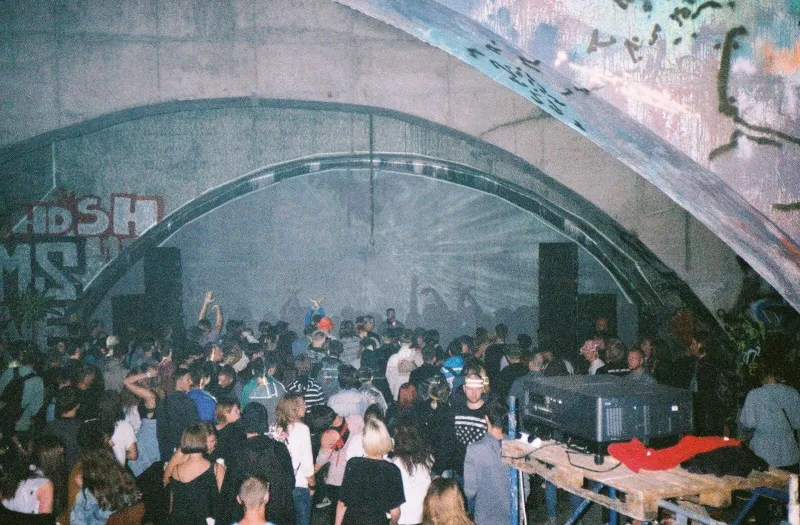
There's a moment that happens at a certain kind of club night — you've probably felt it if you've been lucky enough to be in the room. The music locks in, the crowd stops being a collection of strangers, and something shifts. For a few hours, everyone in that space belongs to each other. That feeling didn't come from nowhere. For a lot of people in the US dance music scene, it came directly from LGBTQ+ club culture.
Queer nightlife didn't just influence electronic music. In many ways, it invented the template. The Warehouse in Chicago, The Paradise Garage in New York — these weren't just clubs. They were sanctuaries, built by and for communities who had nowhere else to be fully themselves. That history runs deep, and right now, a new generation of promoters and DJs is making sure it doesn't get buried under the mainstream's glossy repackaging.
Why These Spaces Still Matter
It would be easy to assume that in 2025, with Pride flags hanging in corporate storefronts every June and major festival lineups featuring openly queer artists, the need for specifically LGBTQ+ spaces in nightlife has faded. Talk to anyone actually building these nights, and they'll tell you the opposite is true.
"There's a difference between being tolerated and being centered," says Marcus, a promoter behind a monthly queer electronic night in Atlanta that's been running for three years. "When you walk into a space that was built for you, by people like you, you carry yourself differently. You dance differently. That's not something a general-admission festival can replicate, no matter how inclusive their messaging is."
Across the country — from the long-established queer club circuits in New York and LA to emerging scenes in cities like Nashville, Phoenix, and Columbus — that distinction is driving real community-building. These aren't niche events clinging to the margins of the industry. They're some of the most culturally vital nights happening in American dance music right now.
The Promoters Building It From the Ground Up
In Los Angeles, a collective called Pleasure Principle has been running monthly queer-focused electronic nights since 2021, cycling through venues from Silver Lake to Downtown. Co-founder Deja, a trans woman who also DJs under the name Spectral Heat, describes the work as part artistic curation, part community infrastructure.
"We do a lot of the things a venue wouldn't think to do," she explains. "We have clear community guidelines posted at the door. We have people on the floor who are trained in de-escalation. We have gender-neutral bathrooms as a non-negotiable. The music is amazing — that part matters — but the safety architecture is what makes people come back."
That combination of intentional safety and high-quality music programming is showing up as a model in cities across the US. In Chicago, a night called Soft Focus has built a loyal following by booking exclusively queer and trans DJs playing everything from deep house to industrial techno. In New York, the legacy of nights like Papi Juice and Bubble_T continues to influence how younger promoters think about intersectionality on the dance floor — events that center queer people of color and refuse to separate musical excellence from community accountability.
The DJs Carrying the Sound Forward
The artists headlining these nights are, in many cases, redefining what dance music can sound like when it's made for a specific community rather than a mass market.
Take Chicago-based DJ and producer Nyx Eternal, whose sets weave together voguing ballroom tracks, hyperpop, and classic house in ways that feel genuinely unclassifiable. "I'm not trying to make music that works everywhere," she says. "I'm making music that works here, for us. And somehow that ends up being the music that moves people the most, because it's honest."
That honesty — the refusal to sand down the edges for broader palatability — is a recurring theme. And it's producing some of the most exciting sounds in American electronic music. Artists like Sasha Geffen, LSDXOXO, and Total Freedom have built international followings precisely because their work is so specifically rooted in queer experience that it carries a kind of emotional specificity that generic club music can't touch.
Pride Season and What's Coming
As Pride season ramps up across the country, the calendar of LGBTQ+-centered club events is fuller than it's been in years. New York's Pride weekend will see multiple competing queer rave events, including rooftop parties in Brooklyn and late-night underground events in Manhattan that run well past dawn. In San Francisco, the tradition of queer dance parties tied to Pride weekend has expanded to include a full week of nightly programming at venues across SoMa and the Castro.
Chicago's North Halsted neighborhood will host a series of outdoor block party events with queer-focused DJ lineups running through late June. And in cities where queer nightlife has historically been less visible — places like Dallas, Denver, and Miami — local promoters are using Pride season as a launchpad for year-round programming, betting that if they build the space, the community will show up and sustain it.
For radio platforms and streaming shows, there's an increasingly important role to play here too. Featuring queer DJs and producers in regular rotation, not just during Pride month, is one of the more meaningful ways the broader dance music media ecosystem can reflect the actual culture it covers.
More Than a Night Out
Ask anyone who's found their people on a queer dance floor, and they'll tell you it changed something in them. Not in a vague, inspirational-poster way — in a concrete, practical way. They found collaborators, partners, chosen family. They found a version of themselves they didn't know existed until the music was loud enough and the room was safe enough to let it out.
That's the thing about the best LGBTQ+ club nights in America right now. They're not just events. They're infrastructure. They're places where community gets built in real time, where the dance floor functions as both celebration and refuge.
The energy in those rooms is different. If you haven't felt it, find your way to one this summer. You'll know it the second you walk in.